AutoMoyu
Auto-fishing for Minecraft Bedrock on Windows. Recasts by watching the held rod, and can hear bites without a fish farm.
Two modes#
AutoMoyu is an auto-fishing tool for Minecraft Bedrock Edition on Windows. It captures the game screen, tracks the state of the held fishing rod, and recasts once the rod has been reeled in. There are two modes, both fully automatic, chosen by where you fish:
- Fish farm: for use with an in-game semi-automatic fish farm. The farm reels in and AutoMoyu recasts.
- Open water: no fish farm needed; aim at any body of water. AutoMoyu detects bites by sound, reels in, then recasts.
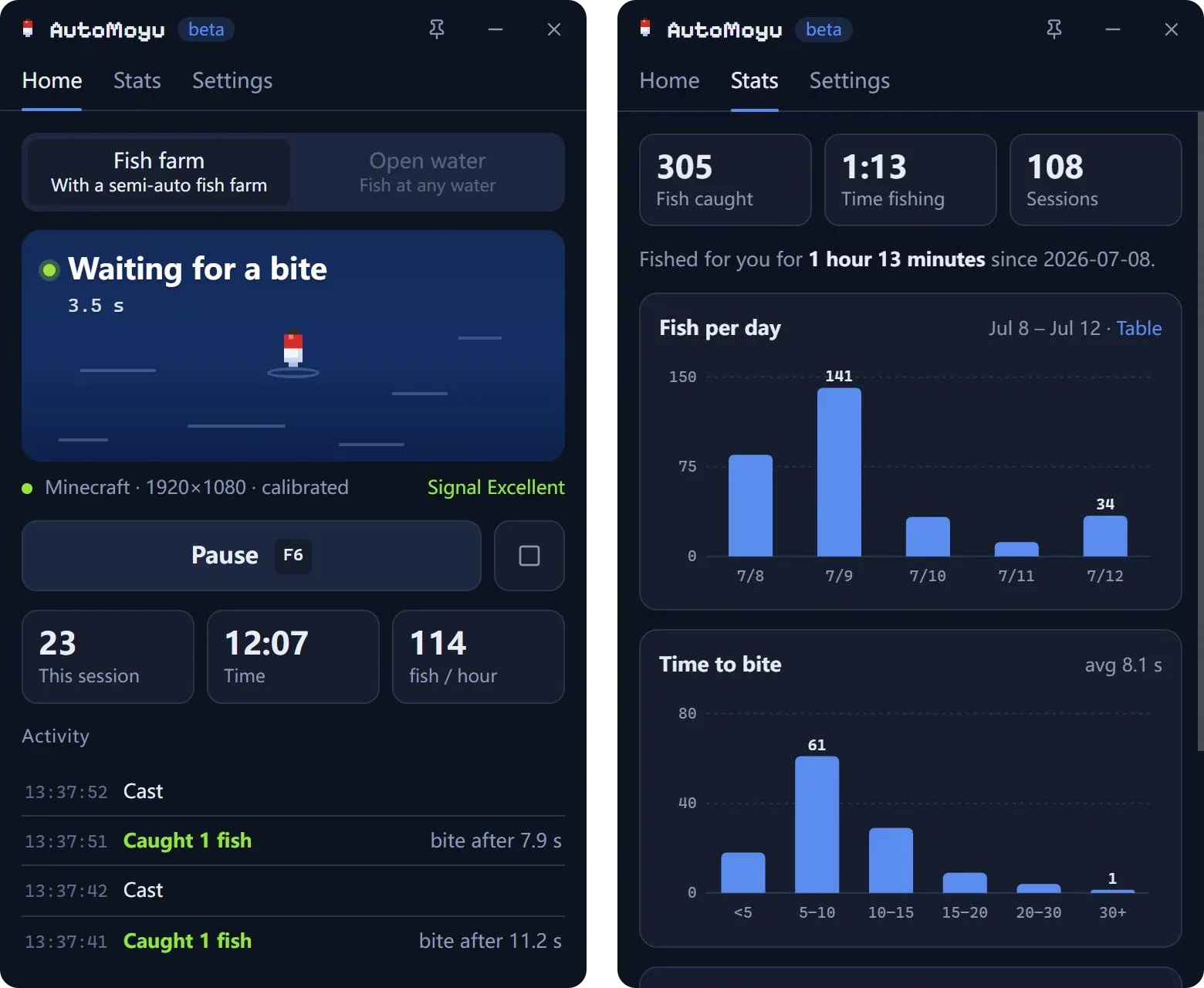
Left: Home shows the current state, this session’s catch and an activity log. Right: Stats summarises fish per day and the time-to-bite distribution.
No manual setup#
On first use the app casts twice on its own to calibrate, which takes about 10 seconds. There is no region to select and no threshold to tune. Calibration is stored per window size and works in daylight, at night and in rain, adapting as brightness shifts at dusk and dawn.
On high-latency servers, server correction can make a fresh cast jump back on screen. AutoMoyu tells these bounce-backs apart from real reel-ins, so it never casts twice. When the player uses the mouse or keyboard in game, it yields control and resumes 5 seconds after input stops. If a cast fails, the rod cannot be recognised or the game exits, it stops and says why.
It also has a system tray icon, an in-game overlay, configurable hotkeys (F6 to start/pause by default), automatic updates with stable and beta channels, and a Chinese and English interface.
How it works#
Rod state: during calibration the app records the screen with the rod reeled in and cast out, slides a window over the area near the held rod and the hotbar, and keeps the small patch where the two states differ most as a pair of templates. While running, it captures that patch 15 times a second and checks which template the frame is closer to. If neither matches, say the inventory is open, the state is “unknown”. Thresholds are derived from the calibration data, so there is no sensitivity slider.
Bite detection: audio is captured from the Minecraft process only, through WASAPI process loopback, so music or voice chat on the computer does not interfere. A bite splash is 0.3 to 0.8 seconds of broadband noise spread across the spectrum, while an approaching fish makes sounds only a frame or two long. The test is therefore “sustained loudness”: within roughly 85 ms, at least 6 of 8 analysis frames must be 12 dB above the noise floor and also clear an absolute gate. That gate is set from the cast sound measured on every cast, so it follows the game’s volume. Cat meows and villager calls are just as loud and long, but they are stacks of harmonics; a per-frame tonality score filters them out.
Input: right-clicks are simulated through Windows SendInput, by default only while the game is in the foreground. The app never reads or writes game memory, modifies game files or injects code. Everything runs locally; the only network access is the update check.
Technical details#
v0.1 was a Python + tkinter prototype that watched the bobber on screen for bites, and its results depended on how the detection box and sensitivity were set. v1.0 is a rewrite on Tauri 2 and Rust: vision now watches the held rod, and bites are detected by sound.
The Rust workspace has three layers. moyu-core holds the detection algorithms and state machine, with no platform APIs and no I/O. moyu-win is the Windows layer: window lookup, screen capture, SendInput, process audio loopback and input hooks. src-tauri is the desktop app, running the service thread, calibration flow, SQLite stats store, tray, overlay and updater. The UI is React + TypeScript + Tailwind.
Because moyu-core does no I/O, the detectors can be replayed against real gameplay recordings. The moyu-bench CLI records frames, audio and the player’s right-clicks as labels, then measures rod-state accuracy, how far apart the two states sit, and bite recall and false alarms offline. Across four recordings in daylight, at night and in rain, rod-state accuracy was above 99%. The old audio test raised 40 to 130 false alarms per 10 minutes; the new one raised none on the two open-water recordings.
Releases run on GitHub Actions: pushing a version tag builds the NSIS installer, signs the update bundle with minisign and generates the update manifest. Pre-release versions go to the beta channel only.
Usage#
Requires Windows 10 version 2004 or later, with the game in windowed or borderless mode. The installer is on GitHub Releases and needs no administrator rights. Many servers prohibit AFK fishing, so check the rules before using it.